
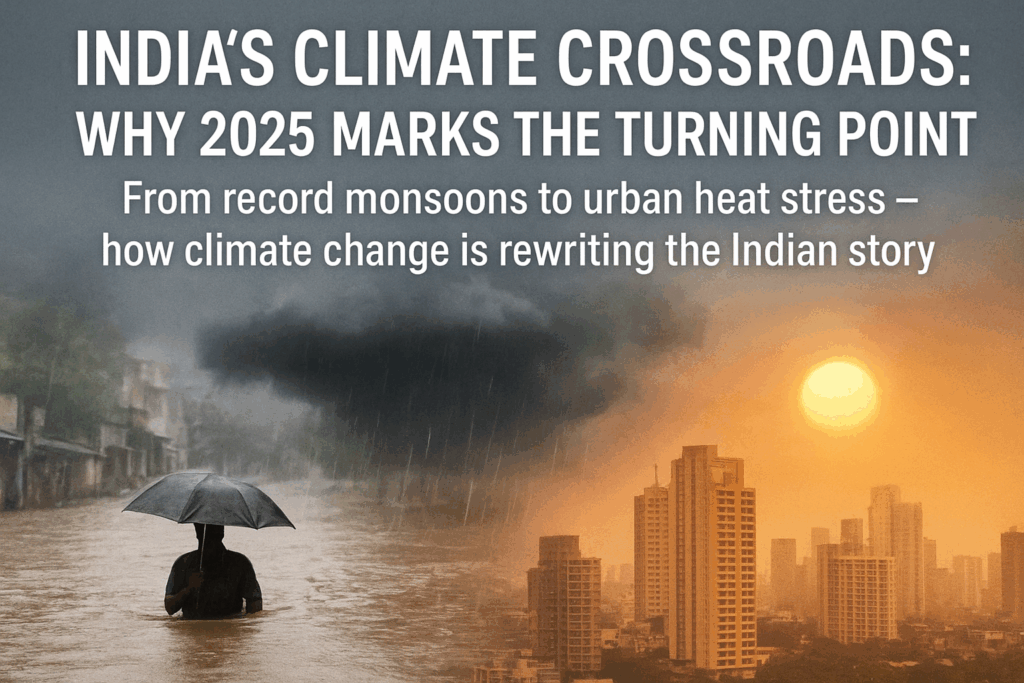
From record monsoons to urban heat stress – how climate change is rewriting the Indian story”
India is facing a pivotal moment. According to recent data, the India Meteorological Department found the 2025 southwest monsoon produced rainfall at 108 % of the long-period average, with 46 % of the country’s subdivisions registering excess rainfall. This extreme rainfall, linked to climate change rather than standard oscillations like El Niño/La Niña, has triggered floods, landslides and widespread disruption.
Simultaneously, urban India is grappling with rising heat stress. A new study found cities such as Ahmedabad and Surat witness significant drops in worker productivity—up to 10 %—due to rising indoor and outdoor temperatures.
On another front, public health patterns are shifting: in Goa the disease Dengue is no longer strictly seasonal but now year-round, owing to warmer temperatures and changing rainfall regimes that boost mosquito vectors.
These converging trends — record rainfall, heat stress, vector-borne disease shifts — reflect that India’s climate change challenge is not distant: it’s active and accelerating. At the same time, India’s climate-policy trajectory shows gaps: according to the Climate Action Tracker, current Indian policies remain “Highly insufficient”, with 2030 emissions projected to be 8–11 % higher than earlier assessments.
You have a strong “turning point” narrative for 2025.
You can structure sections around the three key impacts: extreme rainfall/flooding, urban heat stress/worker productivity, and changing disease ecology.
You should highlight the policy gap and adapt-vs-mitigate dilemma (i.e., building resilience vs cutting emissions).
Use India-specific stats (above) for authority and localisation.
End with clear practical take-aways for your audience (what individuals can do; what businesses/websites can highlight; what policy watchers should note).